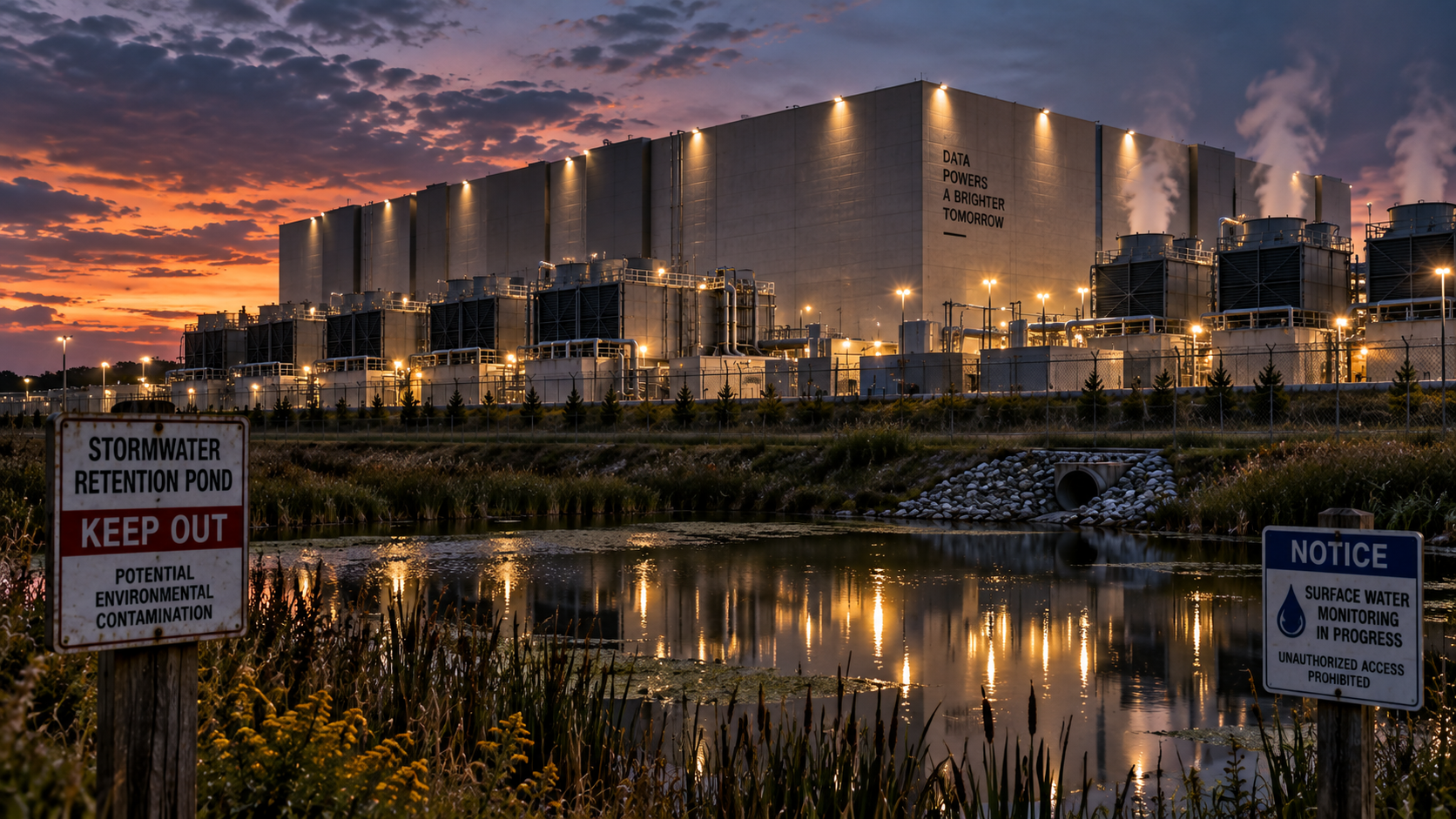
The Guardian reports that chemical manufacturers are scaling up fluoropolymer and PFAS production to serve semiconductor fabrication and data center cooling tied to AI infrastructure. One source in the piece called it a “tidal wave” of new production. It runs directly against the direction of PFAS policy in every jurisdiction that has one.
Most coverage of the environmental cost of AI is about electricity and water volume. Both are real. This is the third leg, and it’s the one that ends up in groundwater.
Where the PFAS goes in a data center
Two places, and a chip fab is a third.
Cooling. Immersion and two-phase cooling systems, which are becoming standard for the high-density racks that run AI models, use engineered dielectric fluids. Many of those fluids are fluorinated, because you need something that doesn’t conduct electricity, doesn’t burn, and boils at a convenient temperature. The same family of chemistry as Novec 1230, the fire suppressant that’s now in East Hampton’s groundwater.
Fire suppression. Data centers can’t use water on live electronics, so they use clean-agent systems: fluorinated ketones and fluorinated gases. Which is exactly what East Hampton’s battery plant used, in bulk, in an emergency, and what DEC has now tied to a plume that traveled half a mile.
Fabrication. Making the chips requires fluoropolymer tubing, fluorinated etchants, and PFAS-based surfactants and photoresists. A semiconductor fab is one of the most PFAS-intensive industrial facilities that exists, and it discharges to a wastewater system that wasn’t built for it.
Why this is a Long Island story
Data centers are coming to the Northeast, and there are industrial parcels on this island in play for them. Two things follow.
The contractors who build and service them take on a fluorochemical exposure profile that almost none of them have assessed. Handling and replacing dielectric fluid, servicing suppression systems, decommissioning equipment: each is a PFAS handling task, and the hazard assessment on most of these jobs still says “electrical” and stops.
And the sites themselves become PFAS sources in a way that the permitting process hasn’t caught up to. A data center’s environmental review looks at power, water, noise, and traffic. It should also look at what’s in the cooling loops and the suppression tanks, how much, and where it goes if there’s a fire or a leak, because as of this week we have a local example of where it goes.
And the discharge. A data center’s cooling system, as I wrote last week, sends blowdown to a sewer district that’s never seen that chemistry. If the fluid is fluorinated, some of it ends up in the effluent, and the sewer district’s PFAS numbers move for reasons nobody on the plant floor connected to the new building in the industrial park. The landfill leachate rule I wrote about three weeks ago is the state chasing PFAS at one end of the waste stream. This is a new source entering at the other.
I said last week that battery storage belongs on the site assessment checklist. Data centers go on the same line. Ask what’s in the tanks before you ask how many megawatts.
What we know
- The Guardian (September 14, 2026) reports chemical manufacturers scaling up fluoropolymer and PFAS output for semiconductor fabrication and data center cooling tied to AI infrastructure.
- The growth runs counter to PFAS restriction policy trends.
What we don’t know yet
- Which specific fluids and volumes are used at facilities proposed for Long Island.
- Whether any state or local permitting process currently reviews data center fluorochemical inventories.
Sources
The Guardian, September 14, 2026: https://www.theguardian.com/environment/2026/sep/14/pfas-firms-tidal-wave-forever-chemicals-ai-industry-demand-datacentres
Corrections: If we got something wrong, tell us at kelly.sacredintel@gmail.com. We fix errors publicly and note the change here.