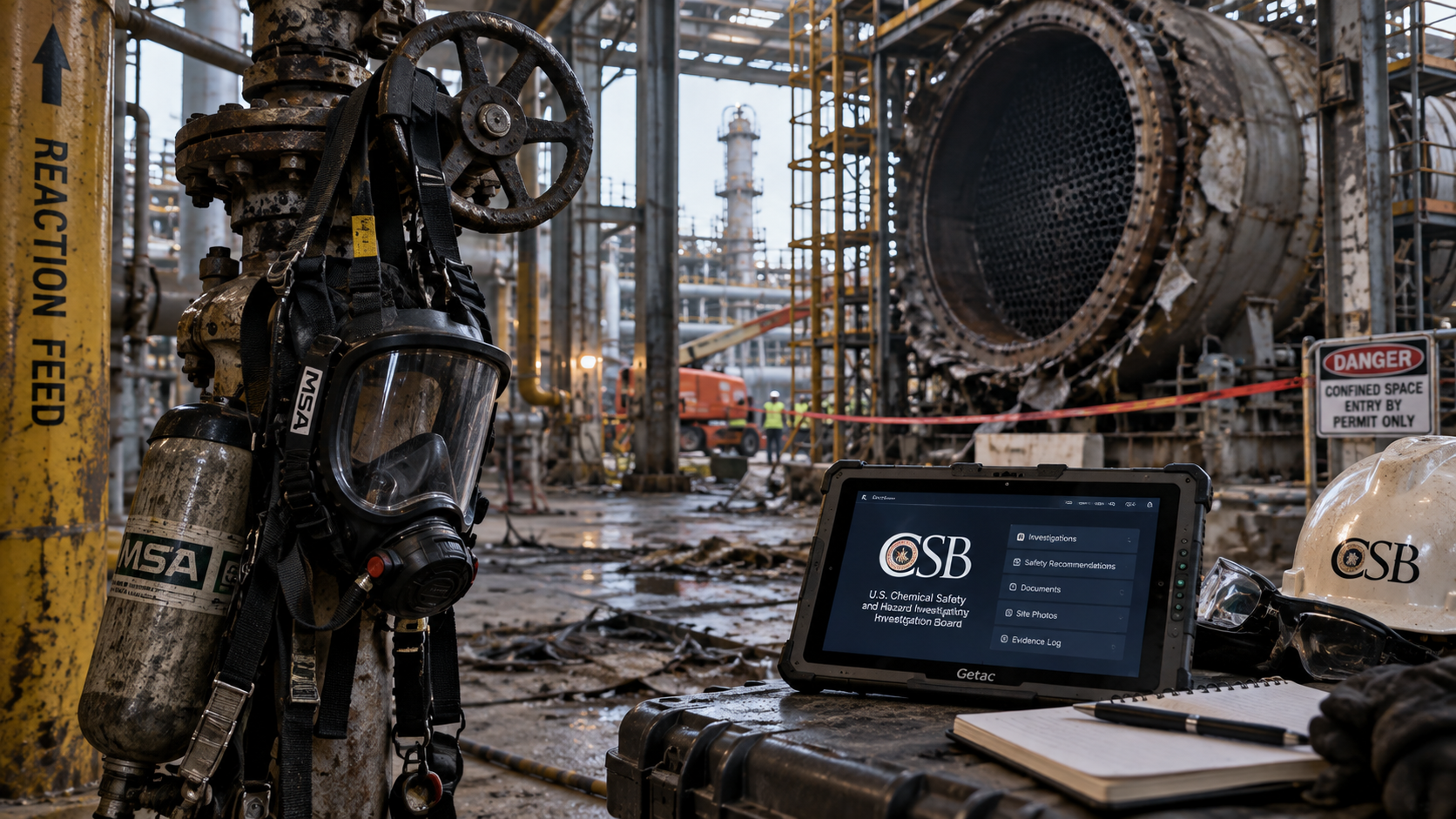
Two workers died and four were seriously injured in April at Ames Goldsmith’s Catalyst Refiners facility in Institute, West Virginia, during a hydrogen sulfide release. On September 1 the Chemical Safety Board issued an investigation update. I’ve read it. It’s short and it’s brutal, and every finding in it is something I’ve seen on a jobsite.
What CSB found
The facility was being decommissioned. Chemicals were being transferred for disposal. There were no written disposal procedures for the chemicals being handled.
There were four respirators on site. None of them had cartridges rated for hydrogen sulfide.
No personal gas monitors were provided or required.
Respirator use had been dropped when the site shifted from operations to decommissioning.
Two of the dead were would-be rescuers who entered the area without protection.
What hydrogen sulfide does
H2S is the gas that smells like rotten eggs, which is the most dangerous thing about it. At low concentrations you smell it. At higher concentrations, above roughly 100 parts per million, it paralyzes your sense of smell within minutes, so the warning goes away exactly when the danger goes up. At a few hundred ppm it causes rapid unconsciousness. At higher levels, one or two breaths can drop you. The IDLH is 100 ppm.
It’s heavier than air, so it collects in low spots, tanks, and pits. And it’s the classic confined-space killer, because the first person goes down, the second person goes in after them, and the second person goes down too. CSB’s update says that’s exactly what happened here.
Why decommissioning is the phase nobody assesses
Here’s the pattern, and if you’ve worked construction or industrial you’ve seen it.
When a plant is running, the hazards are known. There’s a process hazard analysis, there are operating procedures, there’s a respiratory protection program keyed to the chemicals in the process. People wear the gear because they’ve been wearing it for years and it’s the routine.
Then the plant shuts down, and something happens in everyone’s head: the process is over, so the hazard is over. The routine breaks. The procedures were written for operations, not for draining the tanks, so nobody follows them. The respirator program was for the process; the process stopped; the respirators come off. A decommissioning crew, often contractors who weren’t there during operations, gets handed a site with residual chemicals in every vessel and pipe and no document that says what’s in them or how to get it out.
But the chemicals didn’t leave. Residual product in a tank doesn’t know the plant is closed. Transferring it for disposal is a chemical handling operation, with the same hazards as when it was in production, plus a few new ones: non-routine work, unfamiliar crews, improvised methods.
It’s the same thing on a construction demo. The building’s coming down, so the asbestos survey gets skipped. The pipes are coming out, so nobody checks what’s in them. Decommissioning and demolition are the highest-hazard, lowest-assessment phases of the whole lifecycle, and they’re that way because everybody’s mind has already moved on.
The field guide
For anyone who plans, supervises, or walks onto a decommissioning or demo job:
-
A shutdown is a new project, not the end of an old one. It needs its own hazard assessment. What’s in every vessel, line, and sump. Where it goes. How it gets there. Who does it. Written down, before anyone touches a valve.
-
Residual product is product. If it was hazardous in production, it’s hazardous in a drain-down. The controls don’t get to relax because the volume is smaller.
-
Cartridge selection is a chemistry question. A respirator with the wrong cartridge is a mask. H2S needs a specific cartridge or supplied air; it’s not covered by an organic vapor cartridge. Match the cartridge to the hazard, in writing, and check the TC number.
-
Personal gas monitors are not optional where H2S can exist. Four-gas monitors are cheap, small, and loud. If there’s any chance of H2S, everyone in the area wears one, alarms set at the OSHA and NIOSH limits, bump tested daily. This is the control that would have told the first worker to leave before he went down.
-
Rescue is a plan, not a reflex. Two of the dead here went in to help. That’s human and it’s the leading cause of multiple-fatality confined-space and gas-release incidents. The rule is simple and hard: nobody enters an atmosphere that dropped someone without supplied air and a retrieval line. Train it. Drill it. Say it out loud at the start of every shift where it could matter, because in the moment, instinct wins unless the training is louder.
-
Contractors need the site’s knowledge, not just the site’s keys. If a decommissioning crew is walking into a facility they didn’t operate, the handover has to include what’s in everything. That’s the owner’s job. “We don’t know what’s in that tank” is a stop-work condition, not a shrug.
CSB’s final report will have more. The update already has enough to build a toolbox talk. Build it.
What we know
- April 2026 hydrogen sulfide release at Ames Goldsmith’s Catalyst Refiners facility, Institute, WV: two workers killed, four seriously injured. Two of the deaths were would-be rescuers.
- CSB investigation update (September 1, 2026): no written disposal procedures; four onsite respirators, none with H2S-rated filters; no personal gas monitors provided or required; respirator use dropped when the site shifted to decommissioning.
What we don’t know yet
- CSB’s final root-cause findings and recommendations.
- OSHA citation status.
Key facts
H2S IDLH: 100 ppm. Source: NIOSH.
Sources
Corrections: If we got something wrong, tell us at kelly.sacredintel@gmail.com. We fix errors publicly and note the change here.