I’m going to say the obvious thing because somebody has to: the product you buy to kill germs had germs in it.
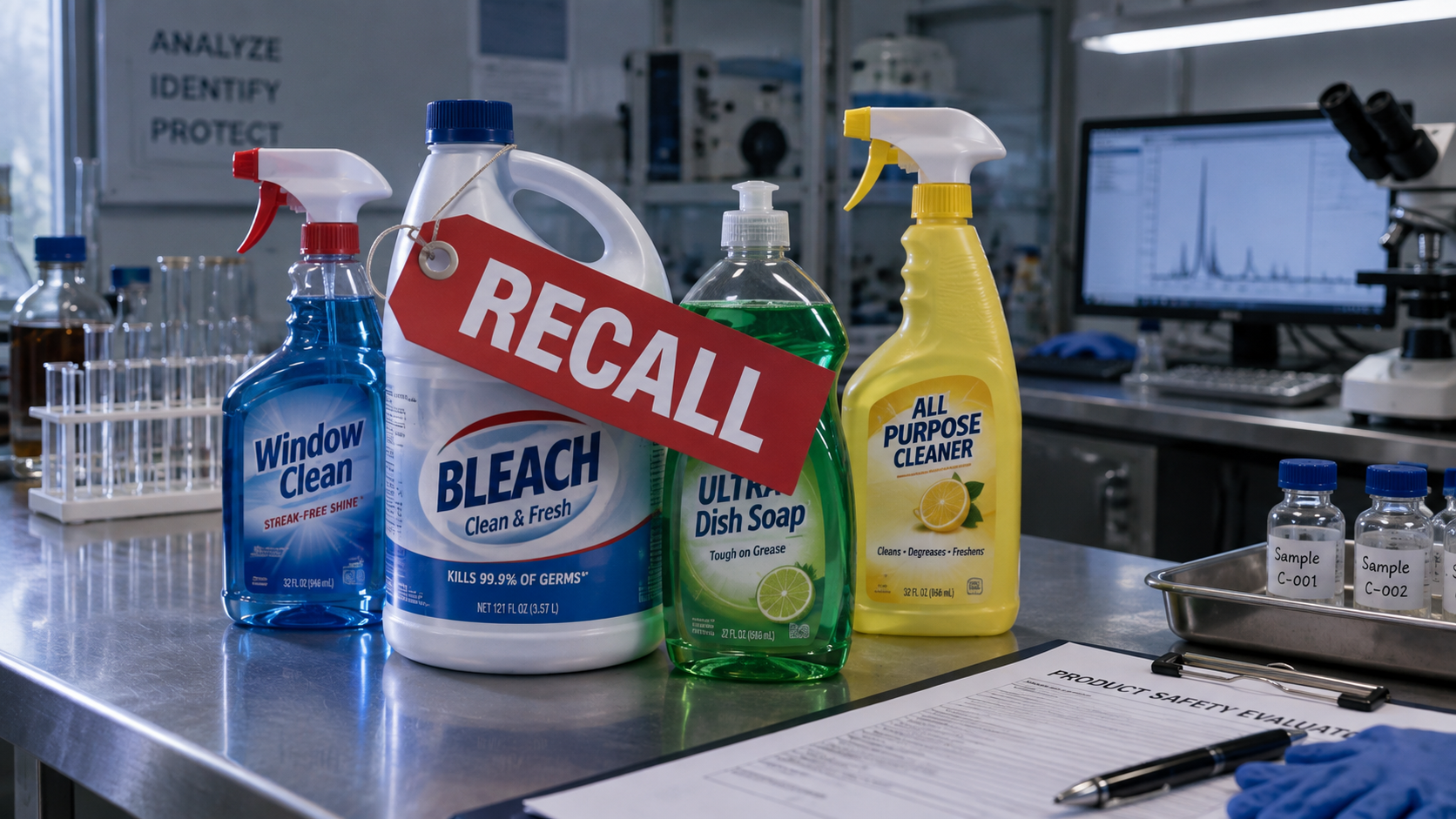
Clorox Puerto Rico recalled about 6.3 million bottles of Mistolin and Lestoil multi-purpose cleaners on September 3 because they may contain Pseudomonas aeruginosa. That’s one of the largest household-chemical recalls of the year, and it’s one of the strangest, because it flips the assumption every home safety checklist is built on.
What Pseudomonas is, and who should care
For most people, Pseudomonas aeruginosa is a nothing. It lives in soil, in water, in your shower drain. It’s one of the most common bacteria on earth and your immune system handles it a hundred times a day without telling you.
For a specific set of people, it’s a real pathogen. It’s an opportunist. It waits for a gap in the defenses and takes it. CPSC’s warning names the population: people with weakened immune systems, and people with external medical devices. Think chemotherapy patients. Transplant recipients. Anyone on immunosuppressants for an autoimmune condition. Anyone with a catheter, a port, a PICC line, a wound vac, a tracheostomy. It’s also a notorious problem in cystic fibrosis, because it colonizes damaged lungs and is very hard to clear.
The routes CPSC lists are inhalation, eye contact, and breaks in the skin. Now think about how you use a multi-purpose cleaner. You spray it. It aerosolizes. You wipe with bare hands. You get it on a cut you forgot you had. Now think about who’s in the room while you’re doing that. Somebody on home oxygen. Somebody doing a nebulizer treatment at the kitchen table. A kid with a scraped knee. A grandparent recovering from surgery.
It’s not that every bottle will make someone sick. It’s that the bottle was supposed to be the one thing in the house you didn’t have to think about.
Why this one bugs me professionally
Every home safety checklist I’ve ever seen, including ones I’ve written, treats cleaning products as a chemical hazard. Don’t mix bleach and ammonia. Ventilate. Store out of reach. Wear gloves. All correct.
None of them treat cleaning products as a microbial hazard, because why would you. The bottle is the thing that’s supposed to be clean. That’s its whole job. This recall says the assumption has a hole in it, and 6.3 million bottles is not a small hole.
It matters more in some settings than others. If you do post-remediation cleaning after a mold job, you’re spraying product in a space where the occupants may already have respiratory issues. If you write indoor environmental quality protocols for healthcare, assisted living, or a home with an immunocompromised occupant, “what’s in the cleaner” is now a question you ask, not a given you assume. Lot numbers, date codes, manufacturer. It’s ten seconds and it’s a line on the protocol from now on.
Manufacturing contamination of liquid consumer products isn’t unprecedented. It’s happened with mouthwash, with saline, with lotions. What’s unusual is the scale and the product category. Cleaners are generally hostile environments for bacteria. Pseudomonas is the one that’s notorious for surviving in places it shouldn’t, including in some disinfectant solutions, which is a fun fact if you’re not the one holding the bottle.
What to do
Check the UPC and date code against CPSC’s recall page. If it matches, stop using it. Don’t pour it down the drain out of spite. CPSC wants you to register online with photos of the codes, and then dispose of the product per their instructions.
If someone in your house is immunocompromised or has an external medical device and has been using it, that’s a call to their doctor. Not to me, and not to a Facebook group.
What we know
- Approximately 6.3 million bottles of Mistolin and Lestoil multi-purpose cleaners recalled by Clorox Puerto Rico, announced September 3, 2026.
- Potential contaminant: Pseudomonas aeruginosa.
- At-risk populations per CPSC: people with weakened immune systems or external medical devices. Routes: inhalation, eye contact, broken skin.
- Consumers register online with UPC and date code photos, then dispose.
What we don’t know yet
- How the contamination entered the product, or how long affected lots were on shelves.
- Whether any illnesses have been linked to it.
Key facts
~6.3 million bottles. Source: CPSC, September 3, 2026.
Sources
U.S. CPSC Recalls: https://www.cpsc.gov/Recalls
Corrections: If we got something wrong, tell us at kelly.sacredintel@gmail.com. We fix errors publicly and note the change here.