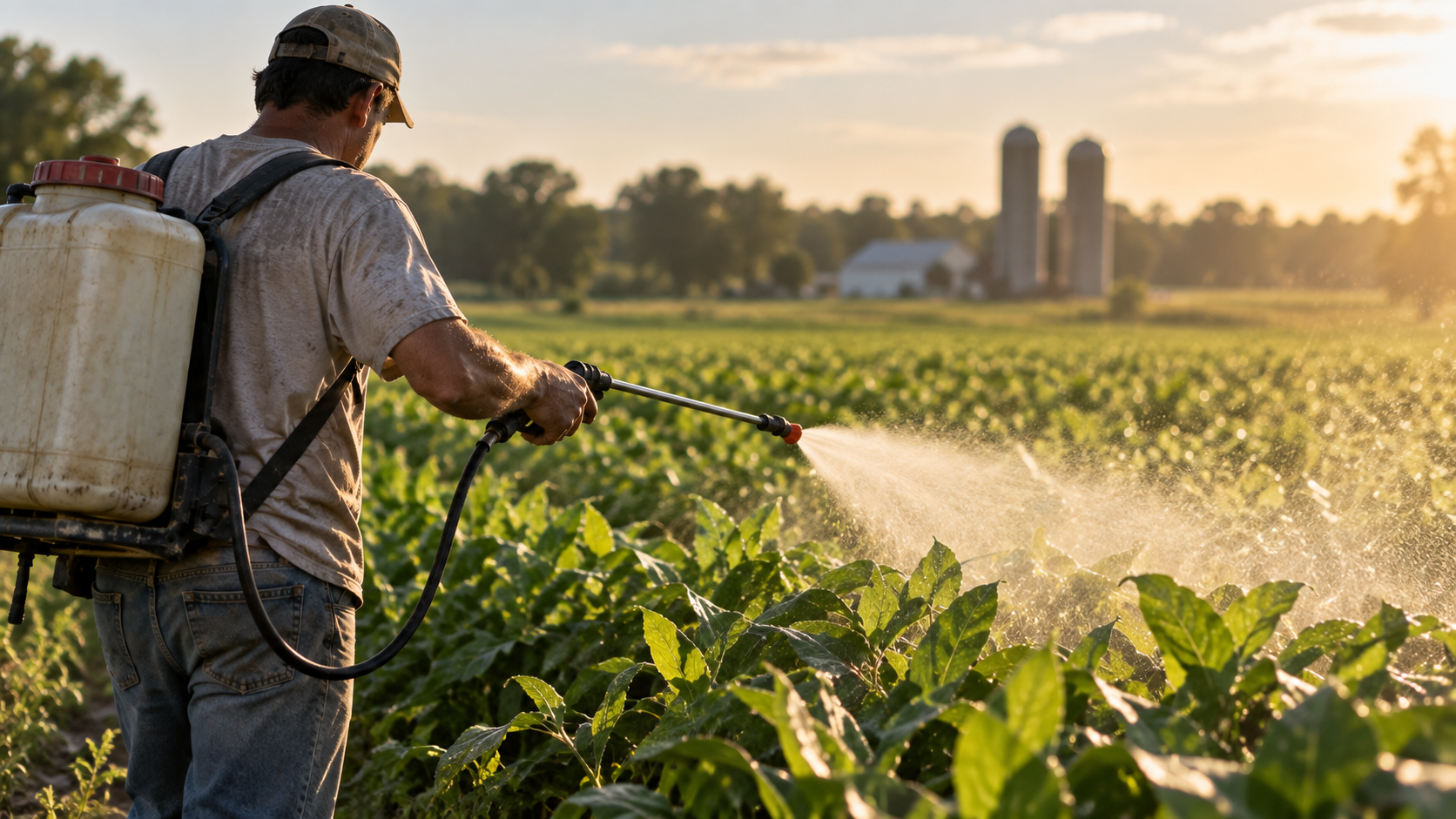
A study in Frontiers in Public Health, commissioned by PAN Germany, estimates 402 to 433 million acute pesticide poisonings a year among the world’s roughly 934 million farmers and farmworkers. Call it 46%. Nearly one in two, every year. Global pesticide use has doubled since 1990, to 3.8 million tonnes in 2023, so the exposure isn’t shrinking.
That’s a big number and I’m not going to pretend it isn’t. But the line in the coverage I keep coming back to isn’t the count. It’s the part where the authors say the count is almost certainly low, and why.
Why the number is a floor
Two reasons, per the authors. Limited access to healthcare, which is obvious: a farmworker in a rural district with no clinic doesn’t get counted because there’s nobody to count him. And a second reason that’s less obvious and more important: clinicians who aren’t trained to recognize pesticide poisoning when it walks in the door.
Read that again. The people whose job it is to write it down don’t know what they’re looking at.
Acute organophosphate poisoning presents as headache, nausea, sweating, blurred vision, dizziness. So does heat exhaustion. So does a stomach bug. So does a bad night. If nobody asks “what were you spraying today,” the chart says gastroenteritis and the case doesn’t exist. Multiply that across a billion people and you get an official number that’s a fraction of the real one. Not because anyone’s hiding it. Because nobody looked.
This is not a farm problem. It’s a surveillance problem, and I see it on jobsites.
A guy spraying two-part spray foam in a crawlspace comes up dizzy with a headache and chest tightness. Nobody thinks “isocyanates.” He goes home, he feels better, it never happened.
A crew runs a generator in a half-open garage in January and two of them go home early feeling like they’ve got the flu. Nobody thinks “carbon monoxide,” even though the symptoms are textbook and the source is sitting right there.
A painter’s hands won’t stop tingling. Nobody thinks “solvent neuropathy.” His doctor says carpal tunnel.
Every one of those is an occupational exposure that became a non-event because the worker didn’t connect it, the urgent care didn’t ask, and the employer never heard about it. That’s the same mechanism that turns 400 million poisonings into a number nobody believes. The incident doesn’t exist because it never got a name.
What to do about it, if you run a program
Document exposures before anyone gets sick, not after. Know what your people are working with, in what quantities, for how long, and write it down while it’s happening.
Medical surveillance isn’t a checkbox for the handful of chemicals with a specific OSHA standard. It’s the mechanism by which you find out something’s wrong while you can still do something about it. If your program only does surveillance for lead and asbestos because those are the ones with a regulation, you’re doing compliance, not safety.
And train your people to say what they were working with when they see a doctor. Write it on a card. Put it in the toolbox talk. Because the doctor probably won’t ask, and the study you just read is 400 million reasons why.
What we know
- Estimate: 402–433 million acute pesticide poisonings annually among ~934 million farmers and farmworkers. Study in Frontiers in Public Health, commissioned by PAN Germany, reported September 7, 2026.
- Global pesticide use: 3.8 million tonnes in 2023, roughly double 1990.
- Authors cite severe underreporting from healthcare access and clinician recognition gaps, and call for phasing out highly hazardous pesticides by 2035.
What we don’t know yet
- The study’s methodology in detail; we’re working from press coverage. Read the paper before citing the number on air.
- How the estimate distributes by region and product class.
Sources
Euronews Health, September 7, 2026: https://www.euronews.com/health/2026/09/07/pesticides-cause-400-million-farmer-poisoning-cases-a-year-study-finds
Corrections: If we got something wrong, tell us at kelly.sacredintel@gmail.com. We fix errors publicly and note the change here.